27 May 2026 · Facebook Ban Service · 9 min read
Facebook mass report tool: what actually gets a Page, profile or group removed
A Facebook mass report tool automates the same complaint against a Page, profile or group from many accounts, promising a takedown once the report count climbs high enough. No tool can deliver that. Facebook removes content only when a review finds a real breach of the Community Standards, so the number of reports never settles the outcome.
Does mass reporting actually work on Facebook?
No. Facebook does not count complaints and pull a Page once they pile up. A report simply asks a reviewer, or an automated system, to check the content against the Community Standards, and an action follows only when there is a real breach to find. Heavy volume might move something into the review queue sooner, but it cannot invent a violation that was never there. Meta's own enforcement pages frame the trigger as a policy review rather than a tally: content is taken down when it goes against the Community Standards, and most violating material is caught by detection systems before anyone reports it. Meta says it removed over 159 million scam ads in 2025, 92% of them before a single user complained. Put plainly: does mass reporting work on Facebook only when each report flags a genuine rule break.
What is a Facebook mass report tool, bot or service?
A Facebook mass report tool is software built to aim the same complaint at one target from dozens or hundreds of accounts in a single burst. You will meet it in three guises: a free auto-reporter script on GitHub, a paid dashboard that sells reports by the thousand, and a "facebook mass report service" run quietly out of a Telegram channel. Every version promises a guaranteed ban, and every version rests on the same false premise, that Facebook keeps a running total of complaints and deletes whatever crosses a secret line. A facebook mass report bot can certainly stuff the review queue. It cannot hand a moderator a violation the page never committed. What changes hands when you buy mass report Facebook actions is the look of progress, not an actual removal.
Is reporting a Facebook page different from a profile or a group?
Yes, and this is where Facebook differs from a single-feed platform. A "target" can be a Page, a personal profile, a Group or a Marketplace listing, and each one runs through its own reporting flow and its own kind of removal. A bot ignores that entirely and sprays identical complaints at whatever you point it at. Reporting accurately means choosing the right surface first: a rule-breaking Page is usually unpublished and then removed, a personal profile is restricted or disabled, a Group can be taken down (and its admins are expected to moderate it too), and a Marketplace listing or seller is pulled under the commerce policies. The table maps how a report on each surface is filed and what removal actually looks like, which is the part a one-click tool can never get right.
| Surface | How you report it | What removal looks like |
|---|---|---|
| Facebook Page | ··· below the cover photo → "Find support or report Page" → choose a category | Page is unpublished, then removed if the breach is confirmed |
| Personal profile / account | ··· beside the name → "Find support or report profile" → pick a reason | Account is restricted, then disabled for serious or repeat breaches |
| Group | ··· → "Report group"; members can also flag it to the admins | Group is removed when its content or core purpose violates policy |
| Marketplace listing / seller | ··· on the listing → "Report listing" or "Report seller" → Scam or fraud | Listing is taken down; repeat sellers lose Marketplace access |
So whether you want to mass report a Facebook page, mass report a Facebook group or report a single profile, the honest version of the task starts by matching the breach to the surface, not by counting how many complaints you can fire. When the target is a person rather than a Page, the same logic drives how to get someone banned from Facebook: report the genuine violation, don't chase a number.
Which Facebook pages and profiles actually get reported and removed?
Only content that maps to a written Community Standard comes down, so a credible report names the exact breach instead of a grievance. In practice the removals that succeed are dominated by deception, which is also the bulk of what an honest reporting service handles. The categories that reliably get a Facebook page or profile actioned are concrete:
- Scam Pages — fake shops, "store closing" cons, prize and giveaway funnels, and crypto or investment schemes promising guaranteed returns
- Impersonation — cloned profiles and Pages copying a real person, brand or business
- Fake business Pages and brand abuse — counterfeit storefronts and review-farming clones
- Marketplace fraud — non-existent listings, no-delivery sellers and off-platform payment tricks
- Harassment, threats and clearly illegal material, with the gravest cases routed to the authorities rather than treated as a takedown alone
The scale is not trivial. The US Federal Trade Commission reported $2.1 billion in losses to scams that began on social media in 2025, with about $794 million of that starting on Facebook, more than any other platform. Meta says it removed 10.9 million accounts tied to scam centres over the same year. "This Page annoys me" maps to no rule and goes nowhere; "this Page is running a crypto-doubling scam" maps to several. Every case where we report a Facebook page through official channels shares one trait: a named, evidenced breach a reviewer can confirm.
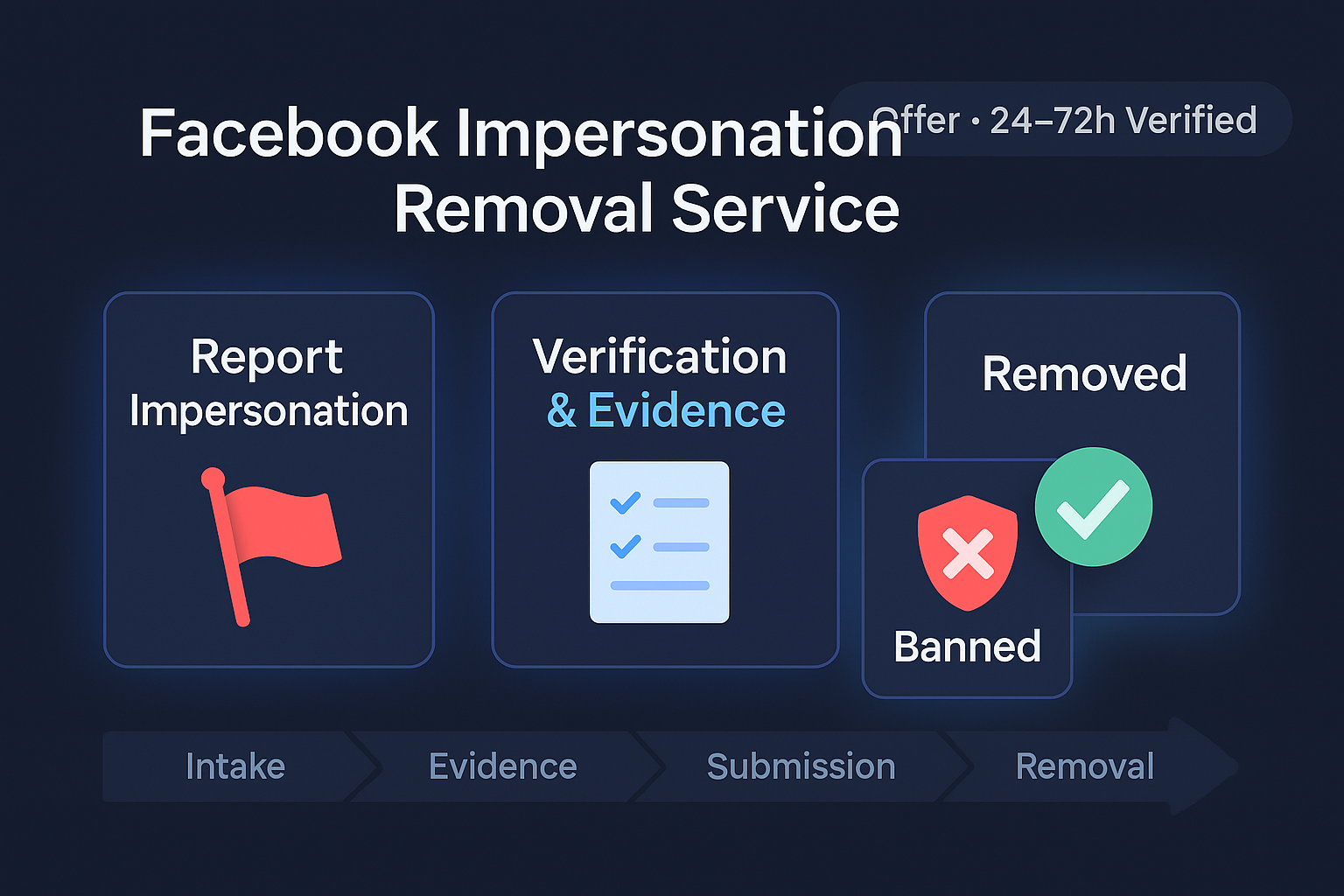
Can you get banned for mass reporting on Facebook?
Yes, and it is the people running the campaign who carry the most risk. Coordinating a pile-on is itself a breach of Meta's rules. The Inauthentic Behavior standard prohibits any attempt to, in Meta's words, misuse Meta reporting systems to harass, intimidate or silence others, and it treats networks of throwaway or fake accounts as a violation in their own right. So the question that usually sits behind a bot — can I get a rival's Group deleted by mass reporting? — has an uncomfortable answer. When no rule is broken the campaign fails, and the coordinated false reports can get your own accounts limited or disabled instead. Facebook's systems are tuned to recognise that exact pattern and discount it. Reporting a genuine violation is safe and welcomed; manufacturing one with a crowd is the part that rebounds on the reporter.
Are free Facebook mass report bots safe to use?
No. Beyond not working, a "free facebook mass report bot" is a well-worn way to lose your own account. Many of these tools, and the lookalike "Facebook help" sites that travel with them, ask you to sign in or paste a token so they can "send the reports for you" — and that login is the key to your entire account, not just your reporting. Security researchers at Malwarebytes put the principle bluntly: a legitimate service will never ask you to hand over your account credentials. One documented case, the fake "Facebook-Help.Report" page, used phoney copyright and deactivation warnings to harvest logins and then lock owners out. Paid panels are no safer: they take crypto, post from disposable accounts Facebook screens out before review, and file nothing you can check. "Guaranteed," "instant" and "undetectable" are the tells.
How do you report a Facebook page, profile, group or Marketplace scam the right way?
You use Facebook's own reporting tools, and a single accurate report does more than a thousand automated ones. "Mass" is the wrong instinct here; precision is what opens a review. The flow barely changes across surfaces, so the steps below cover how to mass report a Facebook account, a Page or a Group without a bot:
- On a Page, tap the ··· below the cover photo and choose "Find support or report Page", then select the category that genuinely fits.
- On a profile, open the ··· beside the name and choose "Find support or report profile" — the route for impersonation and fake accounts.
- In a Group, use the ··· and "Report group"; if you are a member, flagging it to the admins is a faster parallel route.
- On Marketplace, open the listing or seller, tap ··· and report it as a scam or fraud.
- Before anything else, capture the URLs and dated screenshots, and quote the exact Community Standard the content breaks.
That is the honest answer to "how to mass report on Facebook": not a bot, but a precise, evidenced report tied to a rule. Prefer to hand it over? Our team can put the report together and file it for you, or you can see how the wider Facebook Ban Service qualifies a case before anything is submitted. One precise report from the right person beats a bought crowd every time.
None of this argues against reporting. A Page running a scam, a profile impersonating you, or a Group built to defraud should absolutely be reported, and Facebook's official channels are exactly how that happens. What does not work is paying a tool to fake a crowd. When a case is genuine we evidence it, pick the right surface, and leave legitimate pages alone.
Sources
- Meta Transparency Center — Taking down violating content (removal follows a Community Standards review)
- Meta — Integrity Reports H1 2026 (159M+ scam ads removed in 2025, 92% before any report; 10.9M scam-centre accounts)
- Meta Community Standards — Inauthentic Behavior (misusing reporting systems and fake accounts are prohibited)
- Facebook Help — How to report a Page
- Facebook Help — Report a Marketplace scam
- US FTC (April 2026) — People lost $2.1B to social-media scams in 2025
- Malwarebytes (Aug 2025) — Facebook users targeted in login phishing
FAQ
Is there a free Facebook mass report bot that actually works?
No. Free auto-reporter scripts and facebook mass report bot downloads either do nothing or harvest the login you hand them, and the throwaway accounts they post from are filtered out before a human reviews anything. Facebook acts on confirmed violations, so no bot, free or paid, can force a removal.
How many reports does it take to delete a Facebook account or page?
There is no magic number. Facebook does not delete an account or Page once reports reach a threshold, because it never tallies them that way. Removal follows a review that confirms a Community Standards breach, so a single well-evidenced report can outperform thousands of empty ones.
Can a Facebook group be removed by mass reporting?
Only if the Group genuinely breaks the Community Standards. Piling reports onto a group you dislike will not remove it, and coordinating that effort can breach Meta's rules on misusing the reporting system. A Group comes down when its content or purpose violates policy, not when it collects complaints.
How do you mass report a Facebook account through official channels?
You do not need mass, you need one accurate report. Open the profile, tap the three-dot menu, choose Find support or report profile, select the reason that fits, and add the specific posts. For impersonation, reporting it as a fake account pretending to be you is the strongest route.
Is mass reporting on Facebook illegal?
It is not a crime in itself, but coordinated false reporting violates Meta's Inauthentic Behavior policy and can get the accounts behind it restricted or disabled. Filing an honest report about a real violation is always allowed; organising a bot-driven pile-on against an innocent target is not.
How long does Facebook take to review a report?
Often within 24 hours, though complex cases can take several days. You can track the outcome in your Support Inbox, and Facebook will tell you whether the content was found to break the rules. A faster queue does not change the standard the content is judged against.